Thursday, February 21, 2013

Ideas for Art Show

Here are my ideas for the art show. All of these would require a projector, with little to no interaction through mouse or keyboard for the viewer.

1. Sketching of Fernand Leger's Les Disques:
I would use the imitation I created of Fernand Leger's Les Diques (after actually coding all of the "images" from the original) and time it such that each shape comes one by one, telling the narrative of how the piece was created.

2. Live sketching of an art piece
This is similar to the one above, but instead of shapes, this one will draw on a canvas, bringing the drawing into being step by step.

3. Visual music
I would love to do a visual music piece on this song:


 The song has incredible energy and flow, so the visualization should be really interesting to do.

4. Silhouette Garba on "Give me Love" by Ed Sheeran
I'm a Gujarati, and Garba is in my blood (Garba is a traditional dance form in the western part of India, performed during the festival of Navratri). Whenever I listen Ed Sheeran's Give Me Love my feet automatically want to do the steps of Garba because the music is so much like a Garba song. I thought I could create a silhouette, and animate that to visualize the Garba steps I have in my head.

5. Visual Poetry with Graffiti
I wanted to do this for the Visual Poetry assignment but ran out of time. I would put an image of a blank  piece wall in the background, and visualize how a graffiti artist would paint the random poem on the wall. Instead of static backgrounds from google, I will create the backgrounds myself and animate them.

6. Galaxy
I would love to play with 3-D features of processing to create a 3-D galaxy, one that pans and zooms and rotates.

7. Snowfall
All the snowfall yesterday gave me this idea. I could visualize snowfall on Dove Mountain golf course, landing on humongous cacti and other desert shrubbery.

8. Story
Going along with one of my idea for three big projects, I could create an animated piece that tells the story of this song:

9. Supernova
In this piece I would visualize a supernova, how a star collapses on its own gravity and then explodes. Maybe I could find an appropriate piece of music for it too.


Wednesday, February 13, 2013

Three Projects

Here are three projects I'd work on if I had a room for myself, and unlimited resources at my disposal:

1) Maze of Graffiti poems
I got the idea for this from a book called as "Graffiti Moon" by Cath Crowley, in which one of the main characters and his best friend go around painting graffiti on the walls of Sydney in the dead of the night. The paintings are always accompanied by a poem from the best friend, oftentimes making a political statement.

I am enthralled by the idea of finding little surprises like these while walking through a city in the middle of the night.


My project would consist of a maze built into a really large and darkened room. There would be multiple entrances, and the maze would be so large so as to allow the public to see at most 50% of the works before making it to the center (and exit). I want an element of chance to be in it, to really make the public revel in the feeling of being able to see a particular piece, given the design of the maze.

2) Walk through Local group of galaxies
This idea stems through my many visits to science museums and planetariums throughout U.A.E, and also through the astronomy class I took last semester. Again, I'd require a really large room. This project would stimulate a walk through the Local group of galaxies, allowing for interactivity in some way.
It would also stimulate common phenomena like supernovas, black hole accretion , birth of a star, etc. through live models and projections.
See Explanation.  Clicking on the picture will download
 the highest resolution version available.

M82 X-1


3) Storybook room
Stories have always fascinated me, especially the intricate ones. The idea for this stems from visits to the Dubai museum and the Akshardham temple  in Delhi. The Dubai museum is different from other museums in that it tells the story of how Dubai came to be as it is, instead of just presenting artifacts. The visitors have to walk through history itself, past life-sized dioramas of pearl-diving in real, life size dhows, to mud houses in an oasis. The museum depicts every aspect of life in the Dubai of centuries past.

Akshardham does a similar thing, but instead of walking, visitors have to go on a boatride through 50,000 years worth of Indian history. The boat ride is also accompanied by commentary and music.

I'd like to create a storybook room filled with such life-sized dioramas, where the visitors not only hear and see the story, but feel exactly as the characters feel. I want them to feel the rain on their characters faces, the sand on the characters' toes. I want them to feel branches crunch under their boots, and to feel the biting wind that blows through a haunted house.

The story will be narrated to the visitors as they walk through the room, accompanied by music at appropriate places.

Artist Statement

My artwork views the world through a philosophical as well as aesthetic lens. Each of my visual poems is a construction, carefully combining concrete words and abstract images to eternally capture an idea to a wall. I rely heavily on our desire to make sense of the world we live in, our inherent curiosity, and attraction to aesthetic beauty. My artwork is me showing people my solution to this great mystery we call life, one question at a time.
The pieces themselves span a wide range of topics, as diverse as astronomical philosophy, philosophical politics, and holographic introspection. I work from outside-in, always eavesdropping for ideas, experiences, and inspiration in the world around me. Once I have one of these three things, I write the poem and paint the visual poem on paper, often cutting up chunks and rearranging the pieces into a collage. The final draft is always created on a wall.
My biggest inspiration is Sarah Kay, a spoken word poet from New York City. I admire her for her ability to make her audience feel exactly how she feels, at the same time she feels it. I also admire her for her ability to paint abstract vivid images in her audience's minds without once lifting a paintbrush.
It's what I strive for in every one of my works.

Sunday, February 10, 2013

Visual Poetry with Rabindranath Tagore's Fireflies

For this assignment, I chose a paragraph from Old Man And The Sea by Ernest Hemingway as the text and selected lines from Rabindranath Tagore's Fireflies as the template. Here are the lines I chose (each verse is a poem in iteself):

Pearl shells cast up by the sea
on death's barren beach,—
a magnificent wastefulness of creative life.

The lake lies low by the hill,
a tearful entreaty of love
at the foot of the inflexible.

In the drowsy dark caves of the mind
dreams build their nest with fragments
dropped from day's caravan.

In the mountain, stillness surges up
to explore its own height;
in the lake, movement stands still
to contemplate its own depth.

Life's errors cry for the merciful beauty
that can modulate their isolation
into a harmony with the whole.

The cloud gives all its gold
to the departing sun
and greets the rising moon
with only a pale smile.

Wishing to hearten a timid lamp
great night lights all her stars.

For each verse, I created a template and saved it in the "grammar files" folder. Here's how my program generates poems:

1) It first creates a hashmap of arraylists for different parts of speech by parsing words.txt (which I manually created from the text).

2) Then it randomly picks a template from the "grammar files" folder. 

3) For that template, it uses the POS tag as a key to access the above hashmap and create a poem.

4) For the poem, it checks for certain nouns and randomly picks a background from that arrayList. For example, if the poem contains the words "moon" and "sea", it chooses from 5 different possible backgrounds.

5) When the mouse is pressed, it generates a new poem and corresponding background. 

Here are some examples:


Here's the link to the zip folder. I couldn't put it on processing.js because I used BufferedReader.


Sunday, January 20, 2013

MoMA artist assignment

The piece I chose for this assignment is called Les Disques by Fernand Leger. It is an oil painting that uses abstract geometric figures (mainly disks and rectangles) to create a cityscape depicting the view from a railroad car. The disks are meant to represent wheels and the slanting vertical rectangles are meant to represent shafts. There are also many human appearances (engineers on the left and conductors in the middle) despite it being made solely of geometric figures. The painting mostly uses earth colors like ocher, brown, orange, and green. It also uses a lot of gray scale colors, which makes sense as it depicts machinery. Here's the piece:


 The painting was created in 1918, toward the end of World War 1. It is the first in a series of many paintings which center around the theme of "disks". The artist, Fernand Leger, spent the last three years of the war "in the French army's engineer corps" (MoMA website), which was where he got the inspiration for this piece. He firmly believed in the relationship between man and the machine. He called the people in his Disk series Homo faber, or "Man the maker", who then became protagonists in his mechanical universe (collectionsonline.lacma.org).

My immediate aesthetic response to this piece (and the reason I chose to do it) was that it was so colorful. The use of thick borders to highlight certain shapes, along with the contrast of the colorful disks to the gray scale shafts really make the piece stand out.

I think this piece is successful because it shows how even though man has created something bigger than himself, he still manages to control it. This is shown by the way humans are depicted--small, in a huge mechanical world, but in controlling positions.

I think the painting's interpretation is inverted today as compared to when it came out. At that time, technology had just started becoming a part of people's daily lives (especially with the implementation of the assembly line in creating automobiles). Man had created a huge clockwork world, but he was still in charge of it.

Today, man is surrounded even more so by technology. But instead of us controlling it, it controls us. Apart from being completely dependent on our laptops/macbooks/phones/iPads for almost everything, our entire existence depends on technology. If by some random chance (this is just a thought experiment, I really have no idea if this is even possible), the sun were to emit a solar flare with such an intense electromagnetic field that all computers stopped working , it'd be as close to apocalypse as we're ever going to get. Banks, transport, stock markets, governments, and everything else that depends on computers will stop working and our whole world would come to a standstill. How then can we say that we control the technology we created?

Here is my attempt to emulate the piece. The zip file containing the project can be downloaded here.


Sunday, January 13, 2013

ISTA 401 intro

My experience in programming is pretty much limited to what I have learned in CSc 127A, which is an introduction to programming using Java. However, I liked the course enough that I now am  a CS major.
My experience in art is also pretty limited. As a kid I loved everything related to arts and crafts--I'd always take the art elective and work on projects in my free time. My favorite medium was oil pastels. It all stopped once other things started taking precedence--school, books, golf, writing, poetry. I'd love to start creating art again and I'm really excited about learning creative coding this semester.
One media artist I really like is Kurt Schneider--he works with singer Sam Tsui to create youtube covers that integrate different videos of themselves playing different instruments/singing background vocals. Here's a video in which they perform an acapella cover of "King of Anything" by Sara Bareilles.


Here's another one in which Kurt Schneider plays the piano, acoustic guitar, electric guitar and electric keyboard for a cover of "Titanium" by David Guetta ft. Sia.


 The second artist I really like is Nevena Nilolcheva. She first works on pen and paper and then enhances it digitally. I love her work because of the vivid colors and its ethereal quality. The way she incorporates subtle textures into her work is really beautiful.


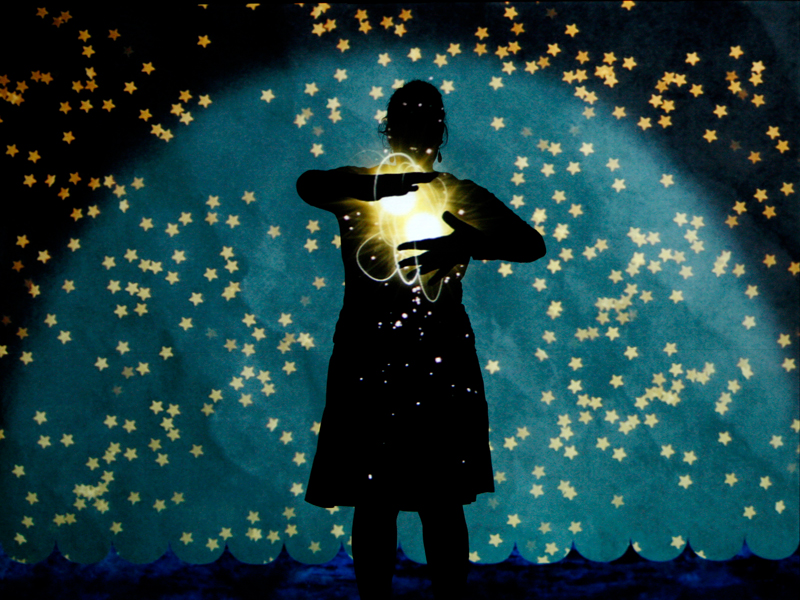
The third artist I really like is Miwa Matrayek, who performs beautiful shows using music, shadows, and art. This video shows her projecting her work on the screen and manipulating it with her shadow. 

It shows three scenes.In the first one, she becomes an island in a creation tableau. I love how the stars are projected, and how they rotate as the seasons change to show the birth of mankind, discovery of fire, extinction of a species through hunting, and finally, the conversion of all trees into a funeral pyre for the man. 


The second one shows her walking through the cityscape. I love the music arrangement here. It's simply mindblowing.

The last scene shows her creating domestic scenes in shadow and video using magical streams of light. I love the way the city surrounds her, as though she is manipulator of it all.